
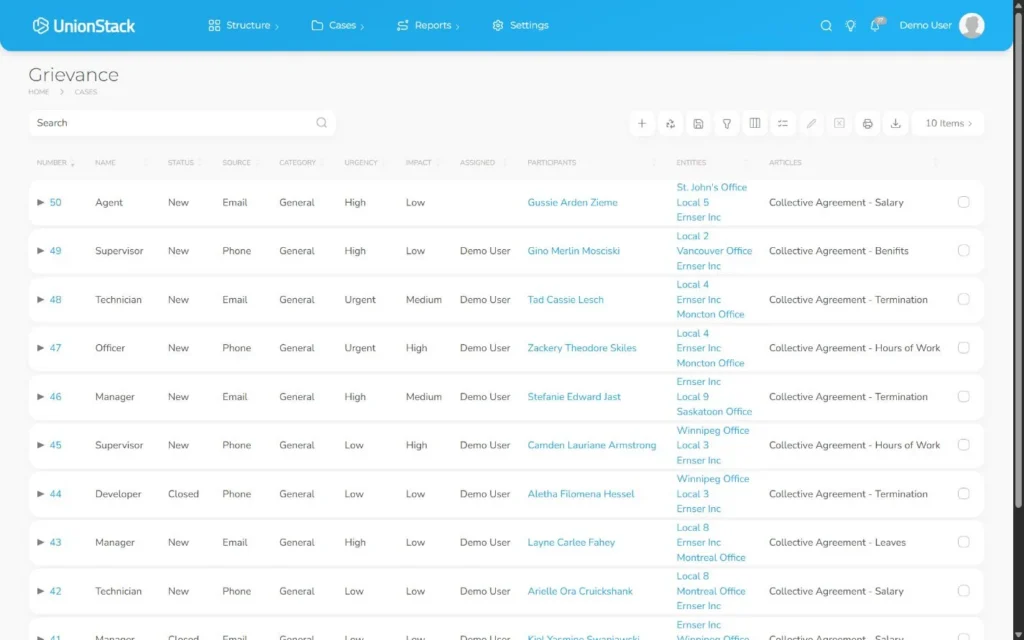
Grievance and case-management software should help an authorized representative understand what happened, who is involved, what procedure applies, who owns the next action and why the matter reached its outcome. A status field alone cannot provide that record.
Every union’s procedures and collective agreements differ. The software therefore needs enough structure to support consistent practice without replacing representative judgment or legal interpretation.
Begin with distinct case types
Grievances, inquiries, incidents, accommodations and other matters may require different information and progress models. A configurable case type can identify relevant intake fields, participant roles, categories, sources, stages, outcomes and supporting records.
Before configuring software, describe the procedure outside the system. Identify the trigger, responsible roles, material decisions, common paths, escalation points and completion conditions. This prevents the interface from becoming the first place the team debates the process.
Capture intake that supports triage
A useful intake record identifies the requestor, concern, channel, source, organizational context and any approved assessment fields such as category, impact or urgency. Required information should support an operational decision; collecting fields without a purpose creates maintenance and privacy obligations.
Test routine and exceptional examples. An urgent matter may need different assignment or escalation, while an incomplete inquiry may require controlled follow-up before it becomes a formal grievance.
Make involvement and responsibility explicit
Participants are not interchangeable. A member, steward, assigned officer, witness, employer representative, legal counsel and decision-maker have different relationships to the case. Participant roles should explain why each person is connected.
Assignment answers another question: who is responsible for moving the work forward? During a demonstration, change the assigned representative and confirm the new owner can find the current stage, evidence, recent communication and next action without a private handover document.
Progress should represent material change
Too few stages hide the procedure; too many stages turn every small task into a status change. Configure progress around material changes in state, responsibility or decision. Subtypes can represent a genuine branch without creating a separate case type for every variation.
Dates and deadlines require governance. Identify which dates come from agreements, legislation, policy or internal targets, who maintains them and how exceptions are approved. Software reminders do not establish the legal meaning of a deadline.
Keep evidence connected to its purpose
Documents, notes, tags, agreements, articles, email conversations and meetings serve different purposes. Connect the original record where possible rather than copying its content into a narrative field.
- Use structured fields for information that must be filtered or reported consistently.
- Use relationships for members, entities, agreements, articles, meetings and related cases.
- Use notes for analysis, decisions and context that cannot be reduced safely to a field.
- Name documents clearly and retain provenance, version and access information where required.
Connect operational email and meetings
A material email thread should remain available to authorized case users even when mailbox ownership changes. Test the provider connection with a controlled conversation, relate it to the grievance and ask another authorized user to find the thread from the case.
Meetings should identify purpose, participants, logistics, supporting documents and their relationship to the case. Follow-up belongs on the record responsible for the action rather than being left only in meeting notes.
Close with a complete result
Before closure, confirm required progress, participants, evidence, communication and final documents. Record the outcome, award, remedy, obligation or other result using approved definitions. Assign any monitoring or implementation work that continues after the case is closed.
A validation exercise is simple: give the record to another authorized representative and ask them to explain the concern, procedure, evidence, decisions, outcome and remaining obligations without consulting the original handler.
Evaluate reporting from maintained case data
Useful operational reporting can show assigned workload, stage, case type or other approved measures. Trend analysis depends on consistent definitions. Buyers should create test cases during the demonstration and require the vendor to produce the report from those records.
UnionStack supports configurable case types, participant roles, assignments, progress, related entities, documents, notes, tags, email, meetings, outcomes and awards. Explore the full grievance tracking workflow and validate it with the maintained case-management guides.
Video demonstration
A captioned UnionStack 2.0 demonstration showing a fake case moving from intake through participants, progress and outcome.
Related product capability
Grievance tracking software
Review the product evidence, buyer guidance and connected workflows behind this article.
Explore Grievance tracking software →