
Workflow context
What this guide helps you accomplish
Relate UnionStack email conversations to the records they concern without duplicating message content.
Relate the conversation to the record that explains why it matters. Keep message content and attachments in the conversation rather than creating manual copies.
A relationship should explain why the email matters while the conversation remains the source for what was actually sent.
Before you begin
Prepare the following before changing shared configuration or records:
- An approved test mailbox or fake conversation and permission from the mailbox owner to connect it.
- A fake case, person or entity that explains why the communication or meeting matters.
- The organization’s rules for sensitive attachments, meeting material, retention and access.
- A fake conversation with a recognizable case reference and harmless attachment.
Procedure
Complete the steps in order with fake or approved test information first. Record configuration decisions that will affect other teams.
Read the full context
Review the thread, participants, subject and attachments before deciding which record owns the operational relationship.
Choose the primary relationship
Connect the conversation to the case, person or entity that best explains why the message matters.
Add other meaningful relationships
Relate additional people or entities only when they help authorized users understand or find the communication.
Keep message content in the conversation
Use notes for analysis or decisions, not as a second copy of the message body. Preserve attachments according to policy.
Review before major decisions
Confirm that material communication is connected before a meeting, submission, outcome or case closure.
Product view
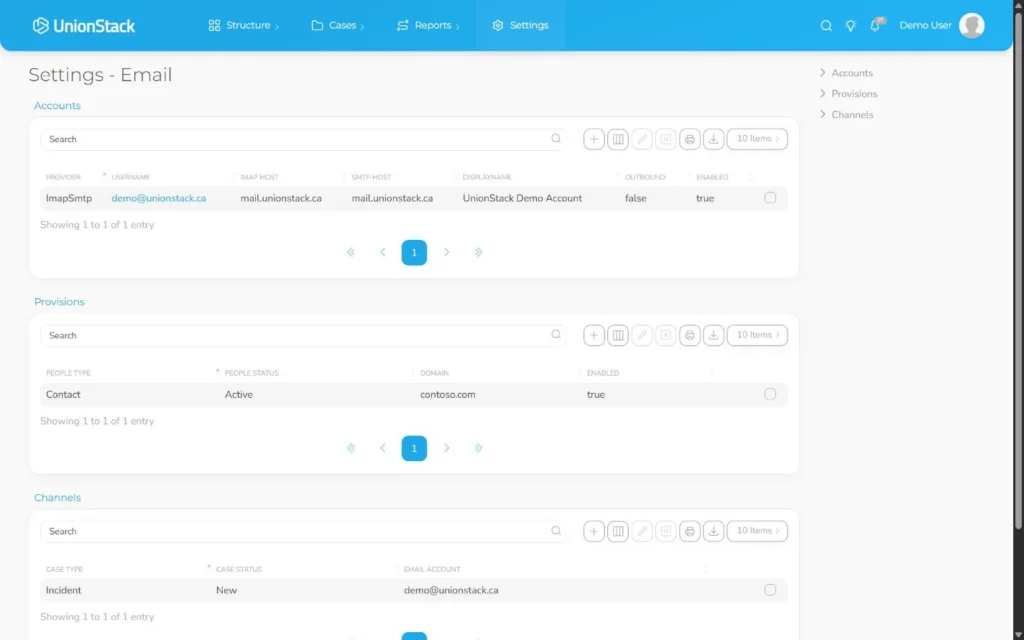
Video demonstration
Related demonstration
Connect email and relate a conversation
This conceptual guide shares the demonstration used by the main hands-on procedure.
Watch the captioned demonstration →Troubleshooting
Use the symptoms below to diagnose the workflow before widening access, adding duplicate configuration or bypassing an intended control.
A conversation relates to several possible cases
Read the complete thread, dates and participants. Choose the primary operational relationship and add secondary links only when they improve authorized discovery.
Provider authorization expires or is refused
Confirm the account, provider and consent screen are correct. Reauthorize through the supported connection flow rather than placing passwords or tokens in notes.
A conversation or meeting is connected to the wrong record
Remove the incorrect relationship through the approved workflow, verify identity and case reference, then connect the authoritative record and document the correction if needed.
Other users cannot find the expected material
Check their access, the relationship to the case or entity, document version and meeting participant records. Do not widen access until the intended audience is confirmed.
Validation checklist
Do not treat the procedure as complete until an authorized second person can reproduce the intended result.
- An authorized user can open the case, find the related conversation and identify its messages and attachments.
- The connected account can complete the intended controlled inbound or outbound test.
- The conversation or meeting is related to the record that explains its operational purpose.
- Participants, recipients and attachments are complete and visible only to the intended users.
- A second authorized user can retrieve the material without searching a separate personal system.
Version applicability
This guide was verified for UnionStack 2.0 on August 16, 2026. Available fields, types, relationships, navigation and access can vary with tenant configuration and user permissions.
Corresponding product capability
Union email management software
See the feature evidence, connected workflows and buyer guidance behind this procedure.
Explore Union email management software →Continue learning
Return to the UnionStack Learning Centre, or take the UnionStack product tour to see how these parts connect.