
Workflow context
What this guide helps you accomplish
Use UnionStack dashboards and reports to guide work while keeping definitions, scope and source quality visible.
Begin with an operational question, then verify definitions, filters and source records before treating a count as evidence or a performance measure.
A report is dependable when its question, definition, source quality and permitted audience are all understood.
Before you begin
Prepare the following before changing shared configuration or records:
- A named owner for the site, report or integration and a written description of its audience and purpose.
- Fake source records that can be published, reported or retrieved without exposing member information.
- A review plan covering access, mobile presentation, errors and the ongoing maintenance owner.
- A written reporting question with expected filters and several known fake source records.
Procedure
Complete the steps in order with fake or approved test information first. Record configuration decisions that will affect other teams.
Start with an operational question
Define the decision or workload question before selecting a dashboard or report. Avoid treating every available count as a performance measure.
Confirm definitions and filters
Review which statuses, types, dates, entities and assignments are included. Document definitions when results are shared.
Check source record quality
Sample the underlying cases, positions, leaders or dues records and resolve material gaps before relying on totals.
Use dashboards for action
Review unassigned cases, open work, approaching events or other indicators with the people responsible for the next step.
Protect exported information
Apply authorized access, distribution, retention and deletion practices to downloaded or shared report data.
Review trends with context
Pair changes in counts with policy, staffing, bargaining and data-quality context before drawing conclusions.
Product view
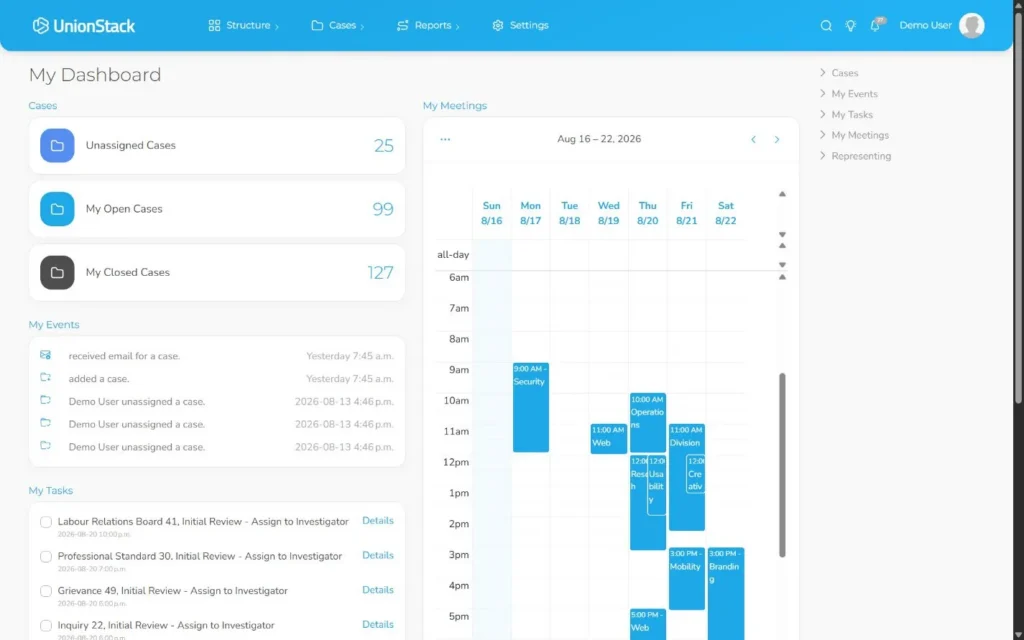
Video demonstration
Follow the principal workflow in this captioned demonstration. The recording uses fake records in the UnionStack test environment.
Troubleshooting
Use the symptoms below to diagnose the workflow before widening access, adding duplicate configuration or bypassing an intended control.
Two users receive different totals
Compare tenant, role, entity, type, status and date filters, then inspect one record included for one user but not the other.
The result exposes too much or too little information
Return to the source record, audience definition and authorization rule. Correct publishing status, filters or access before changing content solely to hide the symptom.
A count or page does not match expectations
Verify source quality, status, effective dates, relationships and filters. Reproduce the result with one known record before changing the configuration.
An external connection stops working
Check ownership, authorization expiry, redirect or domain settings and recent provider changes. Rotate or reauthorize credentials through the approved secure process.
Validation checklist
Do not treat the procedure as complete until an authorized second person can reproduce the intended result.
- The result matches the documented definition and can be reproduced from reviewed source records.
- The intended audience can reach the result and an unauthorized or signed-out user cannot reach protected information.
- Every displayed value can be traced to an understood UnionStack source record or documented calculation.
- Mobile, keyboard, link and error-state checks have been completed.
- An owner and recurring review date are recorded for the live site, report or integration.
Version applicability
This guide was verified for UnionStack 2.0 on August 16, 2026. Available fields, types, relationships, navigation and access can vary with tenant configuration and user permissions.
Corresponding product capability
Union management software
See the feature evidence, connected workflows and buyer guidance behind this procedure.
Explore Union management software →Continue learning
Return to the UnionStack Learning Centre, or take the UnionStack product tour to see how these parts connect.