
Workflow context
What this guide helps you accomplish
Design a UnionStack case type that guides users through a real procedure without hiding necessary judgment.
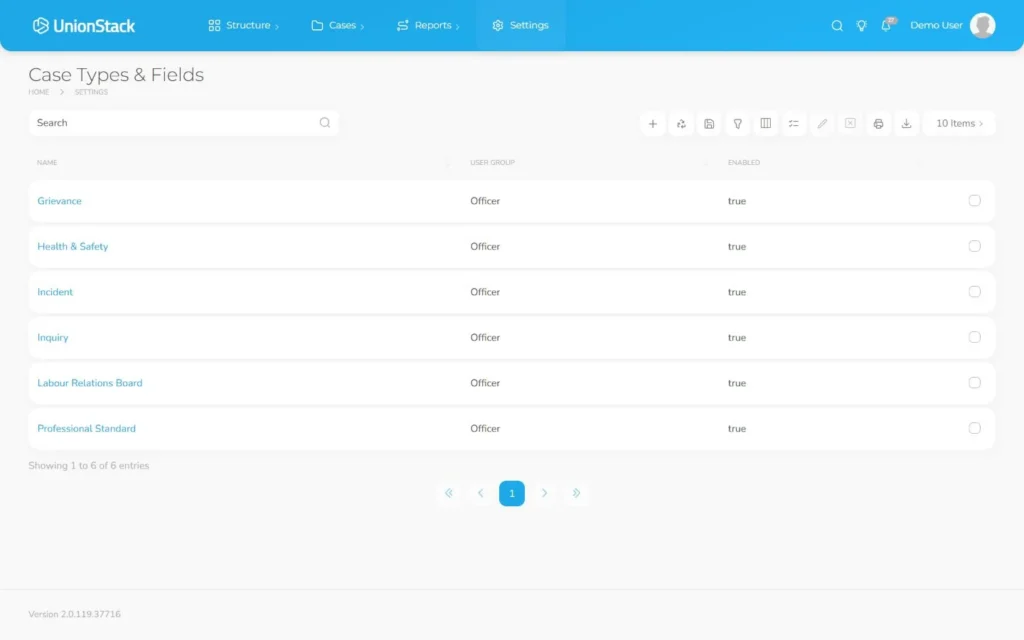
Create separate case types only when the intake information, roles, progress or outcomes differ in a meaningful and repeatable way.
A case type should make the expected path visible while leaving room for the professional judgment the work requires.
Before you begin
Prepare the following before changing shared configuration or records:
- A documented case procedure with intake criteria, participant responsibilities, progress stages and closure expectations.
- A fake member, organizational entity, agreement and supporting documents suitable for an end-to-end test.
- Users representing intake, assignment, investigation and closure responsibilities.
- Two or more real procedure maps showing where information or decisions genuinely differ.
Procedure
Complete the steps in order with fake or approved test information first. Record configuration decisions that will affect other teams.
Describe the procedure outside the system
Document the trigger, responsible roles, required decisions, common paths and completion conditions before configuring screens.
Define intake information
Choose categories, channels, sources, impact, urgency and custom fields that affect triage or later decisions.
Configure participant roles
Name the roles people and users can hold and clarify which are required, repeatable or mutually exclusive.
Build meaningful progress stages
Use stages that represent material changes in responsibility or state, not every small task. Add subtypes where a stage genuinely branches.
Connect supporting records
Decide how documents, notes, meetings, email, entities, agreements, articles and related cases will be used.
Test several scenarios
Walk a routine case, an urgent case and an unusual case through the configuration with the people who perform the work.
Product view
Video demonstration
Related demonstration
Progress a case from intake to outcome
This conceptual guide shares the demonstration used by the main hands-on procedure.
Watch the captioned demonstration →Troubleshooting
Use the symptoms below to diagnose the workflow before widening access, adding duplicate configuration or bypassing an intended control.
Users routinely choose the wrong case type
Clarify labels and intake criteria, remove overlapping types, and add guidance at the selection point before adding another type.
The case cannot move to the expected stage
Check the selected case type, current progress state, required information and user access. Complete or correct the missing prerequisite before bypassing the designed path.
Participants are present but responsibility is unclear
Review each participant role and the assigned UnionStack users. Use roles to describe involvement and assignments to make operational ownership explicit.
Evidence is scattered across notes, files and email
Identify the authoritative source for each item, connect the conversation or document to the case, and use notes for analysis rather than duplicate copies of evidence.
Validation checklist
Do not treat the procedure as complete until an authorized second person can reproduce the intended result.
- Pilot users select the intended type for ordinary and boundary examples and can explain the difference.
- The requestor, participant roles and assigned users are unambiguous.
- Progress accurately reflects the work completed and the next required action.
- Material documents, conversations, meetings and governing articles are connected to the case.
- Closure records the approved outcome or award and leaves a usable operational history.
Version applicability
This guide was verified for UnionStack 2.0 on August 16, 2026. Available fields, types, relationships, navigation and access can vary with tenant configuration and user permissions.
Corresponding product capability
Grievance tracking software
See the feature evidence, connected workflows and buyer guidance behind this procedure.
Explore Grievance tracking software →Continue learning
Return to the UnionStack Learning Centre, or take the UnionStack product tour to see how these parts connect.