
Workflow context
What this guide helps you accomplish
Maintain contact and location information in UnionStack with clear sources, preferences and review practices.
Structured contact fields support search and communication; notes should capture context rather than become a second, stale address book.
Contact data is operationally valuable only when its source, recency and permitted use are understood.
Before you begin
Prepare the following before changing shared configuration or records:
- An approved naming standard and a clear source for identity, position, organizational and agreement information.
- A representative branch of the union structure, including the relationships that make the records meaningful.
- Fake people and position records that can be changed safely during testing.
- An authorized fake contact update with a known source and preferred communication channel.
Procedure
Complete the steps in order with fake or approved test information first. Record configuration decisions that will affect other teams.
Confirm the authorized source
Identify whether the person supplied the information, it came from an employer feed or it was verified through another approved process.
Record contact details consistently
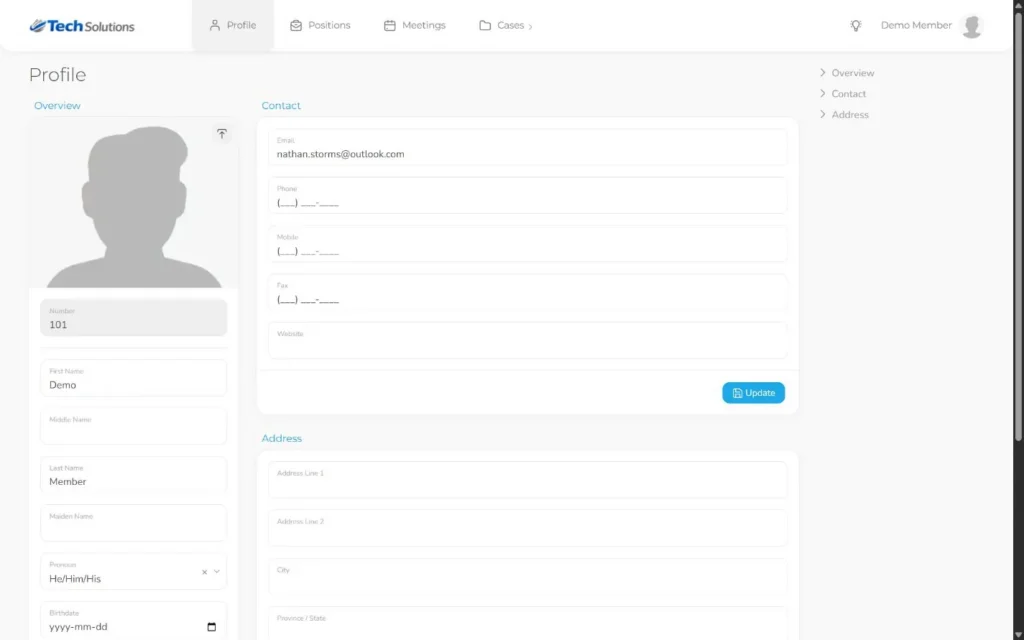
Use the correct email, phone and location fields so information remains searchable and available to connected workflows.
Respect contact preferences
Record and follow the organization’s approved approach to preferred channels, unavailable channels and communication restrictions.
Avoid copying contact data into notes
Keep structured contact information in its designated fields. Use notes only for context that cannot be represented safely elsewhere.
Review changes and duplicates
When new details arrive, verify the person and update the existing record instead of creating a second identity.
Product view
Video demonstration
Related demonstration
Create a person and connect a position
This conceptual guide shares the demonstration used by the main hands-on procedure.
Watch the captioned demonstration →Troubleshooting
Use the symptoms below to diagnose the workflow before widening access, adding duplicate configuration or bypassing an intended control.
A new email address creates a second person
Search by other identifiers and inspect connected positions before creating a record. Update the authoritative person after identity is confirmed.
A person or entity appears more than once
Stop before adding another record. Compare identifiers, contact details and connected positions, then use the organization’s correction process to preserve the authoritative record.
A relationship is technically valid but confusing
Open both connected records and confirm the relationship label answers a useful operational question. Rename or remove relationships that staff cannot interpret consistently.
A report does not match the expected structure
Inspect the underlying type, status, effective dates and entity relationships before changing the report. Correct the source record and rerun the same filter.
Validation checklist
Do not treat the procedure as complete until an authorized second person can reproduce the intended result.
- The preferred contact details appear once, have a known source and are available to the intended connected workflow.
- The record can be found using the identifiers and terminology staff actually use.
- Current and historical relationships are distinguishable without overwriting useful history.
- A user can move from the person to the relevant position, entity or agreement in context.
- A sample report produces the expected population after source records are reviewed.
Version applicability
This guide was verified for UnionStack 2.0 on August 16, 2026. Available fields, types, relationships, navigation and access can vary with tenant configuration and user permissions.
Corresponding product capability
Membership management software
See the feature evidence, connected workflows and buyer guidance behind this procedure.
Explore Membership management software →Continue learning
Return to the UnionStack Learning Centre, or take the UnionStack product tour to see how these parts connect.