
Workflow context
What this guide helps you accomplish
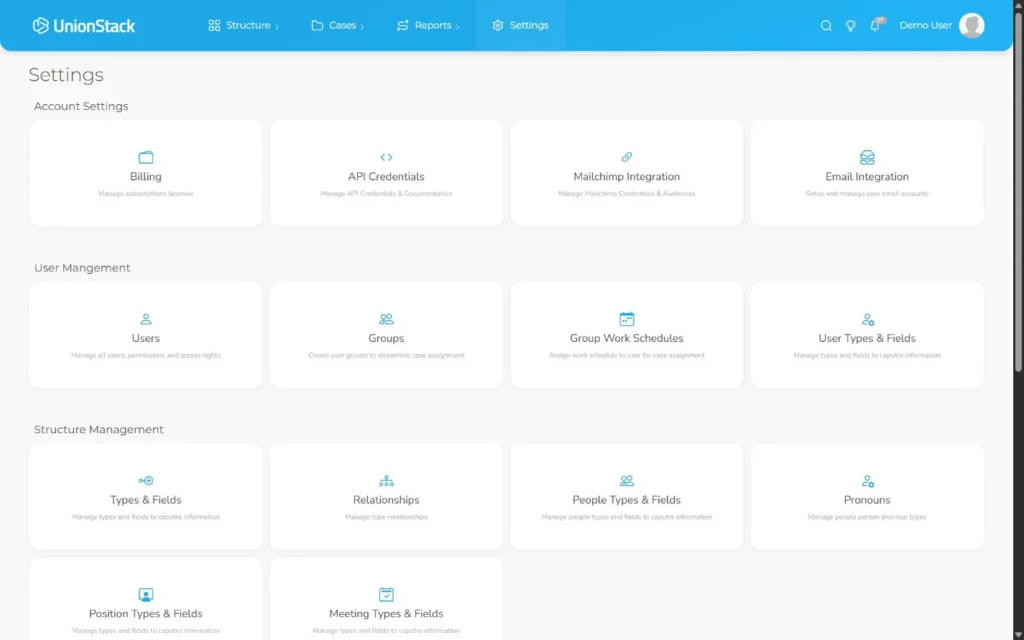
Design UnionStack types and custom fields around decisions, filtering and dependable procedures.
Types and custom fields should change a decision, search, relationship or report. Every field also creates a maintenance obligation, so start with the smallest useful model.
Good configuration captures meaningful differences while keeping the shared model easy to explain.
Before you begin
Prepare the following before changing shared configuration or records:
- Administrator access to a UnionStack test organization and a written description of the procedure you are configuring.
- A small set of fake records that covers an ordinary example and at least one exception.
- A named configuration owner who can approve terminology, access and any change to shared settings.
- Examples of the current forms and reports that justify each proposed field.
Procedure
Complete the steps in order with fake or approved test information first. Record configuration decisions that will affect other teams.
Inventory current terminology
Collect the names used in forms, spreadsheets, policies and everyday conversation. Reconcile duplicate labels before reproducing them in the platform.
Choose the correct record family
Decide whether the concept belongs to a person, organizational entity, position, case or meeting. Keep information on the record that owns and maintains it.
Create only fields with a purpose
For every custom field, identify who supplies it, when it is required and how it will be used. Avoid collecting information simply because it was available in an old file.
Standardize values where consistency matters
Use configured choices for information that must be filtered, reported or interpreted consistently. Reserve free text for context that cannot be reduced safely to a list.
Test with representative records
Create several realistic examples, including unusual cases. Confirm labels, help text, required status and value choices before wider use.
Document ownership and review
Assign responsibility for approving new types and fields. Review unused or overlapping configuration on a regular schedule.
Product view
Video demonstration
Follow the principal workflow in this captioned demonstration. The recording uses fake records in the UnionStack test environment.
Troubleshooting
Use the symptoms below to diagnose the workflow before widening access, adding duplicate configuration or bypassing an intended control.
A field is frequently left blank or filled inconsistently
Confirm who owns the value and when it becomes knowable. Improve the label or choices, move it to the correct record, or remove it if it has no operational use.
Users describe the same concept with different names
Pause configuration and reconcile the labels used in policies, forms and everyday work. Choose one preferred term and document any legacy synonyms for onboarding.
A pilot user can see too much or too little
Compare the user’s actual responsibility with the planned access matrix. Correct the role or group assignment, then repeat the test with a second representative account.
The configuration works only for the sample record
Add an unusual but valid scenario and trace it through the same procedure. Adjust the model only when the difference affects a real decision, relationship or report.
Validation checklist
Do not treat the procedure as complete until an authorized second person can reproduce the intended result.
- Every configured field has an owner, a collection point and a documented reason for existing.
- A second administrator can explain the configuration and its owner without relying on undocumented knowledge.
- A pilot user can complete the intended task without a spreadsheet, private note or duplicate record.
- Names, statuses and structured choices match the approved terminology list.
- Access was tested with representative non-administrator accounts.
Version applicability
This guide was verified for UnionStack 2.0 on August 16, 2026. Available fields, types, relationships, navigation and access can vary with tenant configuration and user permissions.
Corresponding product capability
Union management software
See the feature evidence, connected workflows and buyer guidance behind this procedure.
Explore Union management software →Continue learning
Return to the UnionStack Learning Centre, or take the UnionStack product tour to see how these parts connect.